Misconceptions about Severance Pay in Korea
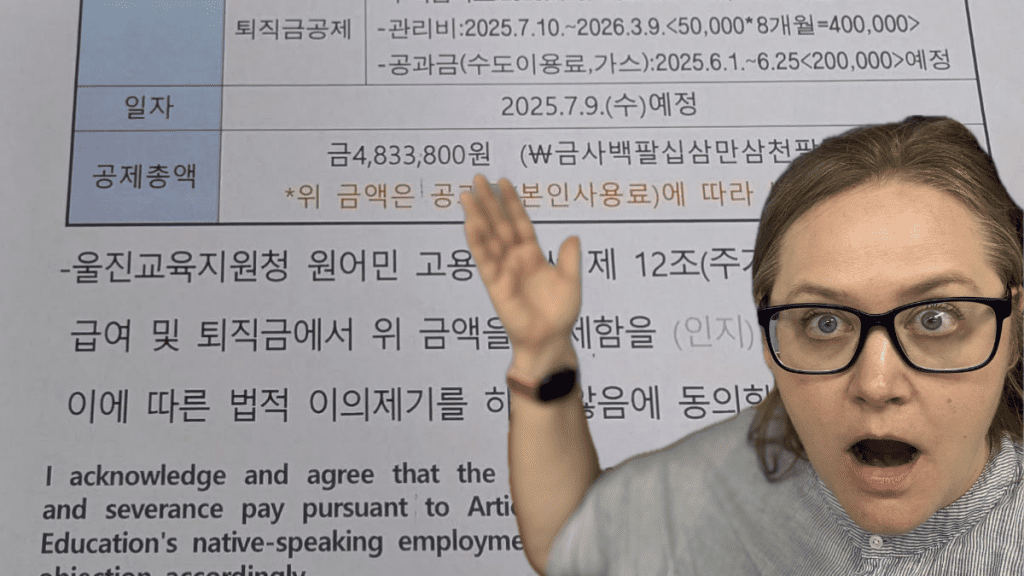
Online, you may come across different information regarding Severance Pay in Korea that may or may not be true. Here are several common misconceptions foreign ESL teachers in South Korea may hold about severance pay (퇴직금). We will also provide some clarifications based on common understanding of Korean labor law. Disclaimer Nothing in this blog post exists as legal advince. Information and laws may change over time. Consult an attorney if you have questions about your Severance Pay while living in South Korea. We’ve used ChatGPT to summarize our research regarding some of the most common misconceptions about Severance Pay. The following informaiton is based on legal information, lived experiences, and interviews. Misconception 1: “I only get severance if I finish my contract.” Fact: You are entitled to Severance Pay in Korea as long as you have worked at least one full year, regardless of whether: After you work one full year, your future severance becomes prorated if you leave partially through any year after that. Reference: Labor Standards Act, Article 34 Misconception 2: “Foreigners don’t get severance.” Fact: Foreign workers have equal rights under Korean labor law. If you’re classified as an employee (근로자), you are entitled to severance. This is true regardless of your visa type or nationality so it doesn’t just apply to English teachers in South Korea. Keep in mind, if you are classified as an independent contractor it’s a different story. However, this does not mean employers won’t attempte Reality: Please take time to reflect on the fact that “equal rights” doesn’t always mean equal treatment or equal legal enforcement in real life. Employers in Korea (like employers in other countries) who know their former employee is leaving the country may take advantage of the situation. Many employers know that teachers who excite the country struggle to follow up on labor issues. Misconception 3: “My monthly severance pay is being given with my salary.” Fact: It’s illegal for employers to include severance in your monthly wage unless it’s part of a certified retirement pension plan (퇴직연금). If your boss says, “Your salary includes your severance,” ask for documentation proving enrollment in an approved severance account (e.g., NH, Samsung Life, KDB, KB). Misconception 4: “I need to apply to get my severance.” Fact: No application is necessary. Once your employment ends (after 1+ year), law dictates that your employer to calculate and pay your severance within 14 days. Misconception 5: “University or part-time jobs don’t give severance.” Fact: Even part-time or university positions must pay severance if: MOEL Reference: https://www.moel.go.kr Misconception 6: “The employer can NEVER deduct losses or fees from my severance.” Fact: Under Korean labor law, employers cannot deduct losses or penalties (such as training fees, visa sponsorship costs, or airfare reimbursements) from your severance pay (퇴직금)—even if the employee leaves early—unless the deduction meets very specific legal conditions. However, such conditions are rare but not non-existant. It’s generally know that the Article 20 of the Labor Standards Act (근로기준법) explicitly prohibits contracts that impose financial penalties on employees for ending their employment early. These “liquidated damages” or penalty clauses are illegal, even if they appear in a signed contract. In addition, Article 43 of the same law requires that wages must be paid in full. This includes Severance pay. HOWEVER, it also states “unless a clear, lawful deduction is agreed upon (such as a loan or wage advance)” and even then, it cannot reduce the Severance Pay below its legal minimum. KEY POINTS:Your employer cannot subtract claimed “losses” from your severance pay unless: REALITY: Some grey does exist and teachers need to be very careful about what you sign regarding your employement. For example, some employers may argue/feel that aspects of housing costs can come out of severance if you leave your contract early. They may or may not win this argument based on the individual situations. SO DON’T SIGN EXTRA PAPERWORK. If something sketch is happening you, contact the Ministry of Labor at 1350 (press 4 for English) to learn more about your rights. REALITY: You might have to wait on hold Just stick with it. Misconception 7: “The employer CAN deduct losses or housing costs from my severance.” Fact: Some ESL contracts include an Article 20 or similar clause that allows employers to recover housing-related costs. This might include such things as unpaid rent, early lease termination penalties, or damages if a teacher leaves early. Employers, including public schools, may try to deduct these costs from severance pay. However, under Article 20 of the Korean Labor Standards Act (근로기준법 제20조), employers cannot generally impose penalties or liquidated damages for breach of a labor contract. This means they cannot pre-authorize deductions from severance pay for general “losses” related to housing, training, flights, or early resignation. This includes even if such a clause appears in your contract. Misconception 8: “Employers always understand and follow labor laws correctly.” Fact: While many Korean employers (Well, employers globally really) may know the basics of labor law, some may misunderstand or ignore requirements around severance, wage protection, and prohibited deductions. Not all employers: This lack of understanding leads to miscommunication, improper contract wording, illegal deductions, or delays in payment. This often occurs without malice, but due to ignorance or lack of legal guidance. When dealing with these issues, it’s helpful for teachers to: What if They Try to Collect Losses Anyway? If you cause verifiable, documented damage to the employer’s property or housing (e.g., broken lease fee that the employer had to cover), your employer may request compensation. However, compensation must be settled separately, and cannot be automatically deducted from your severance unless: THEREFORE, DON’T SIGN ANYTHING! Your employer may attempt to preasure you into signing a paper saying they can deduct damages but YOU DO NOT HAVE TO SIGN THIS! Run all paperwork past legal council before doing anything. The following is actual paperwork handed to TikToker TheBlerdExplorer when he left his contract early. (Follow his experience on his TikTok Channel) Key Takeaway: If your teacher contract has Article 20 that allows the employer to deduct unspecified housing losses from your severance, it may be unenforceable under Korean labor law. Severance is a protected wage benefit and can only be withheld or reduced under very strict conditions. SO DON’T SIGN ANYTHING! What to Do if Preassured to Sign Documents The following is not legal advice. However, it is what’s recommended on legal sites. If your school pressures you to sign documents that they can deduct expenses from your Severance Pay, please do the following: Misconception 9: “Since what my employer did is illegal, I’ll be able to leave Korea with my full severance easily.” Fact: Even if your employer is clearly violating Korean labor law, this does not guarantee you’ll receive your severance before leaving the country. Or, in truth, even at all, without taking action. Many teachers assume that the law will protect them automatically, but in practice: REALITY: Remember that Korean labor law is enforceable, but you must file a claim and follow legal procedures which can take time and employers know this. Severance pay is not automatically “unlocked” by the system if the employer refuses to pay. It’s also not confiscated or redistributed by the government. You have to get them to give it to you. In practical application, you shouldn’t plan on leaving Korea until 14 days after you leave your job or until you get all of your money from your employer. However, if you leave Korea and haven’t been paid: Additional Article About Foreign ESL Teacher Severance Pay (Coming Soon) South of SeoulFounded in 2015, the South of Seoul team consists of volunteers on three continents working together to support English-speaking people traveling or living in South Korea. South of Seoul volunteers work with organizations and individuals across South Korea to improve equitable access to information across South Korea. Much of South of Seoul’s information focuses on Pyeongtaek, Gyeonggi-do, South Korea. Blogs published under the authorship of “South of Seoul” include blogs compiled by multiple volunteers to improve access to standardized information unrelated to individualized personal experiences. www.southofseoul.net
